


















How Smart Bettors Use The World Cup 2026 Schedule
The World Cup 2026 schedule isn’t just a fixture list, but rather a roadmap for smart bettors looking to stay ahead of the market. With 48 teams, 104 matches, and 39 days spread across the United States, Mexico, and Canada, this is the largest tournament in history.
The expanded format adds another knockout round and introduces real variables that sharp bettors can e...
The World Cup 2026 schedule isn’t just a fixture list, but rather a roadmap for smart bettors looking to stay ahead of the market. With 48 teams, 104 matches, and 39 days spread across the United States, Mexico, and Canada, this is the largest tournament in history.
The expanded format adds another knockout round and introduces real variables that sharp bettors can exploit, from altitude shifts in Mexico to cross-continental travel and condensed rest windows.
That’s where World Cup 2026 smart betting comes into play. While World Cup bookies adjust prices, the edge lies in understanding how the World Cup 2026 schedule impacts performance before the market fully reacts.
- 1. What Are The Key Dates And Stages Of The World Cup 2026 Schedule?
- 2. Why Does FIFA World Cup 2026 Demand A Different Betting Approach?
- 3. What Environmental Factors Do Smart Bettors Track?
- 4. How Do Travel Fatigue And Fixture Gaps Affect Sports Betting?
- 5. Are There Dead Rubber Games In The 2026 World Cup Group Stage?
- 6. How Can The World Cup 2026 Schedule Help You Find The Best Bets?
What Are The Key Dates And Stages Of The World Cup 2026 Schedule?
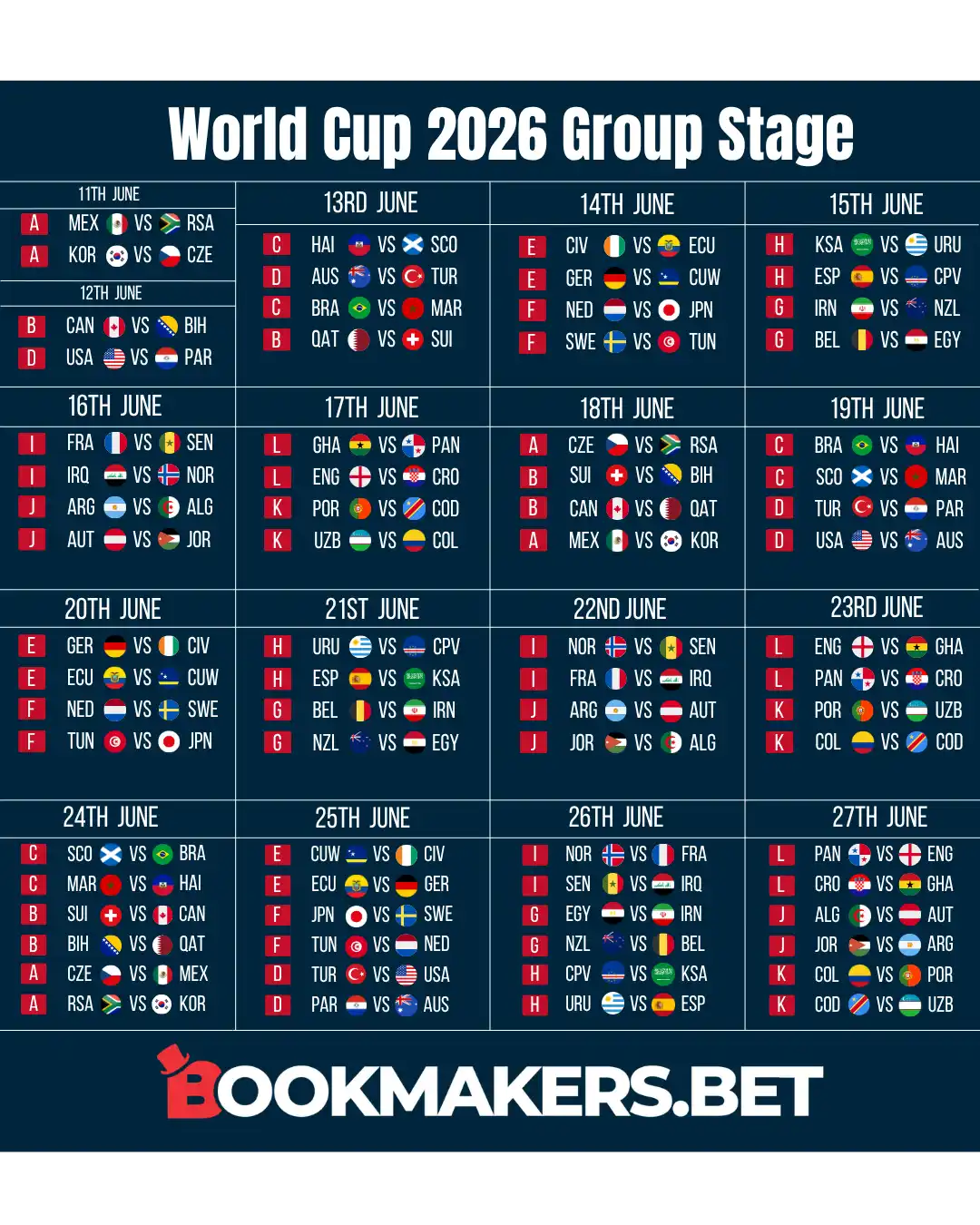
The 2026 World Cup betting schedule runs from June 11 to July 19, spanning 39 days and 104 matches across 16 cities in the United States, Canada, and Mexico. The first match of the tournament will be between Mexico and South Africa at the Mexico City Stadium.
The group stage runs June 11–27, followed by the Round of 32 (June 28–July 3), Round of 16 (July 4–7), quarter-finals (July 9–11), semi-finals (July 14–15), third-place match (July 18), and the final on July 19, which will be held at at MetLife Stadium in East Rutherford, New Jersey.
| Round | Dates |
|---|---|
| Group stage | June 11-27 |
| Round of 32 | June 28-July 3 |
| Round of 16 | July 4-7 |
| Quarter-finals | July 9-11 |
| Semi-finals | July 14-15 |
| Third-place play-off | July 18 |
| Final | July 19 |
Why Does FIFA World Cup 2026 Demand A Different Betting Approach?
The 2026 FIFA World Cup breaks from every previous edition in ways that directly impact 2026 World Cup betting strategy. A denser schedule means more matches, more World Cup betting markets, and more fatigue, which creates opportunities for bettors who can spot value early.
Add in the three-host format across the United States, Canada, and Mexico, and you get a level of travel and environmental complexity the tournament has never seen before. Here’s a glance at our World Cup Betting Tips.
How does the round of 32 change the betting strategy?
The round of 32 is a brand-new knockout stage, added with the expansion from 32 to 48 teams, and it reshapes how bettors approach the bracket. The top two teams from each of the 12 groups qualify automatically, along with the eight best third-place f...
The round of 32 is a brand-new knockout stage, added with the expansion from 32 to 48 teams, and it reshapes how bettors approach the bracket. The top two teams from each of the 12 groups qualify automatically, along with the eight best third-place finishers.
That opens up new “To Qualify” markets, especially for teams sitting on the edge of progression. It also means finalists must now win eight matches instead of seven, increasing fatigue, rotation, and injury risk. With this round played across six days, it creates a key betting window before the market fully adjusts.
Betting on the tournament hosts
For the first time in World Cup history, three nations share hosting duties, with the USA, Canada, and Mexico all in play. That creates a clear home-betting angle, since each host nation will play its three group-stage games on home soil.
Hosts typica...
For the first time in World Cup history, three nations share hosting duties, with the USA, Canada, and Mexico all in play. That creates a clear home-betting angle, since each host nation will play its three group-stage games on home soil.
Hosts typically land in favorable groups and avoid top seeds, making Group Winner World Cup odds and markets worth a close look. Mexico adds another layer with altitude in Mexico City and Guadalajara.
Travel is also a factor, with trips like Vancouver to Miami stretching over 4,000 km. That kind of movement impacts recovery. At the same time, patriotic betting at North American World Cup betting sites can inflate the prices of the USA and Mexico, opening value on the other side.
What Environmental Factors Do Smart Bettors Track?
Three host countries bring three distinct climates, and conditions will vary sharply from venue to venue throughout the tournament. That’s where sharp bettors find an edge and exploit World Cup betting mistakes. This happens because most casual players ignore how weather, altitude, and travel impact performance from match to match.
Altitude venues and how to bet on mismatches
Mexico City’s Estadio Azteca sits at roughly 2,240 meters above sea level, while Guadalajara’s Estadio Akron comes in around 1,560 meters. The altitude is a massive game-changer. Reduced oxygen levels impact recovery, limit sprint output, and often slow matches, especially for teams arriving from sea level.
It’s a spot where scoring rates can...
Mexico City’s Estadio Azteca sits at roughly 2,240 meters above sea level, while Guadalajara’s Estadio Akron comes in around 1,560 meters. The altitude is a massive game-changer. Reduced oxygen levels impact recovery, limit sprint output, and often slow matches, especially for teams arriving from sea level.
It’s a spot where scoring rates can dip. The angle is simple. When a European or South American side travels into altitude on short rest, the under 2.5 goals market becomes very playable. When playing at altitude, we can see fewer goals scored because they are difficult to come by.
There’s also a built-in edge for teams based in Mexico during the group stage, as they’re already acclimated compared to opponents flying in.
Weather conditions across three host countries
Matches in Texas and Florida will be fairly hot. Cities like Arlington, Houston, and Miami regularly exceed 30°C in June and July, often with high humidity. That’s a significant factor, especially for European teams kicking off at midday local time.
Second halves can slow down, and legs begin to tire. That’s where second-half unders and even to...
Matches in Texas and Florida will be fairly hot. Cities like Arlington, Houston, and Miami regularly exceed 30°C in June and July, often with high humidity. That’s a significant factor, especially for European teams kicking off at midday local time.
Second halves can slow down, and legs begin to tire. That’s where second-half unders and even total corners under come into play. It’s a different look in Canada. Toronto and Vancouver offer cooler conditions that favor high-pressing sides.
Also worth noting, domed venues like AT&T Stadium in Arlington remove weather from the equation and should be handicapped accordingly.
How Do Travel Fatigue And Fixture Gaps Affect Sports Betting?
The spread of venues across three countries and multiple time zones creates travel demands we’ve never seen at a World Cup. Some teams will cover 4,000+ km between group matches depending on their draw, while others stay in a tight regional pocket.
We will see the biggest impact late in games. The staggered schedule also creates uneven rest, with some sides getting two extra days before knockout matches. Before betting on winners in the round of 32 and round of 16, map travel and rest off the official schedule and price that into your number.
Iran’s border-crossing disadvantage
Geopolitical tensions forced FIFA to approve relocating Iran's World Cup base camp from the USA to Mexico. Of course, this creates a major logistical nightmare for the Asian team, since they have to play all their group-stage games in the USA. On June 15, they face New Zealand in Inglewood; on June 21, they play against Belgium at the same venue; and on June 26, they confront Egypt in Seattle.
The US government’s refusal to permit overnight stays means the squad faces a gruelling routine: crossing the borders, dealing with excessive customs checks, and flying directly back to Mexico after every game. This procedure should add extra fatigue, making Iran a prime live betting target.
Live betting opportunities during fixture congestion
The round of 32 packs eight matches into six days, creating a tight live betting window with plentiful edges. Fatigue becomes visible. Teams on short rest press less, sit deeper, and start making substitutions earlier, usually around the 60-minute mark.
That’s where live match markets come into play. Next Goal and Asian Handicap lines are especially valuable when a better-rested side is chasing against a fatigued opponent. Add in confirmed team news and visible rotation, and you’re already ahead of pre-match numbers. It’s also a spot where World Cup bet offers can be leveraged, as books adjust more slowly than the match dynamics.
Are There Dead Rubber Games In The 2026 World Cup Group Stage?
“Dead rubbers,” or indifferent games, are matches where one or both teams have already advanced or eliminated before kick-off. They’re harder to spot in 2026, as the eight best third-place rule keeps goal difference in play.
When they do show up, rotation is common, shrinking the gap between favorites and underdogs and flattening moneyline prices. Matchday 3, June 24–27, is the key window to target.
Group stage betting markets to target in dead rubbers
The draw becomes very playable in three-way moneyline markets, as motivation levels flatten and neither side is fully committed to chasing a win. Under 2.5 goals is another strong angle, with rotated squads leading to lower tempo and fewer clean chances.
Total corners Under also fits, as attacking phases drop and set pieces become less frequent. That said, there’s a flip side. If both teams still need to boost their goal difference to secure a third-place spot, Matchday 3 can swing aggressively, making over 2.5 total goals a live play and spotting World Cup odds for value bets.
How Can The World Cup 2026 Schedule Help You Find The Best Bets?
Treat the schedule like a checklist before you ever look at a price. Build your position from rest, travel, and conditions first, then compare it to the market.
Most bettors skip this step, even while flipping betweenWorld Cup live streaming sites, and that’s where the edge shows up. Run through this before every bet.
What to ask
What to check
Check rest days
How many days have passed since each team's last match?
Check travel distance
Did either team cross time zones or travel 3,000+ km since their last fixture?
Check venue conditions
Is it a venue at high altitude or exposed to extreme weather conditions? Is it domed?
Check motivation
Does either team have nothing to play for?
Check squad depth
Have the teams already played many matches in the tournament? Do they rotate and have a strong bench?
Check live betting lines at kick-off
Pre-match lines often lag behind confirmed team news and late rotation decisions.
Frequently Asked Questions
The tournament runs from June 11 to July 19, 2026, across 39 days. It will be the first to feature 48 teams, significantly increasing the number of matches and betting opportunities.
The top two teams from each of the 12 groups advance automatically, along with the eight best third-placed teams. This creates a new knockout round, meaning teams must now win eight matches to lift the trophy.
Teams may travel over 4,000 km between matches, crossing time zones and limiting recovery. Short rest and long trips can reduce late-game intensity, creating betting edges for fitter or better-rested opponents.
There's a reason why World Cup futures exist, so the answer is definitely "yes". Markets related to the World Cup winner, Golden Boot winner, Top Scorer, the teams that will win groups and those that will be eliminated, as well as daily game markets and team props, are very popular.
Many online sportsbooks offer World Cup bonuses and promos. This includes welcome offers for new customers, as well as free bets, enhanced odds, ACCA boosts for multiple selections, and money-back specials, depending on your betting activity.
A total of 104 matches will be played, making it the largest World Cup ever, with games spread across 16 cities in the USA, Canada, and Mexico. Check our detailed World Cup guides before you place your wagers.
Mexico City and Guadalajara sit at an elevation, with thinner air impacting stamina and tempo. Matches there often slow down, making under goals markets and fatigue-based angles more appealing, especially for teams not acclimated.
Spain is the heavy favorite according to the World Cup betting odds, followed by France, England, Argentina, Brazil and Germany.
Dead rubbers are group stage matches where teams have nothing to play for. Rotation is common, reducing intensity and narrowing the gap between sides, which often impacts totals and moneyline pricing.